NEW REPORT · SEPTEMBER 2026
Colorado’s
Hospital Provider Fee
Protecting Medicaid coverage and access to care for Coloradans.
See how Colorado’s hospital provider fee strengthens the health care safety net and supports access in communities across the state.
Explore the report
Turn the pages online
Read the report here, or download a copy to keep. Use the controls to move through the report or open it in full-screen mode.
Report Resources
Fact sheets at a glance
Explore and share key topics from the report.
HPF History and Structure
Download PDF ↓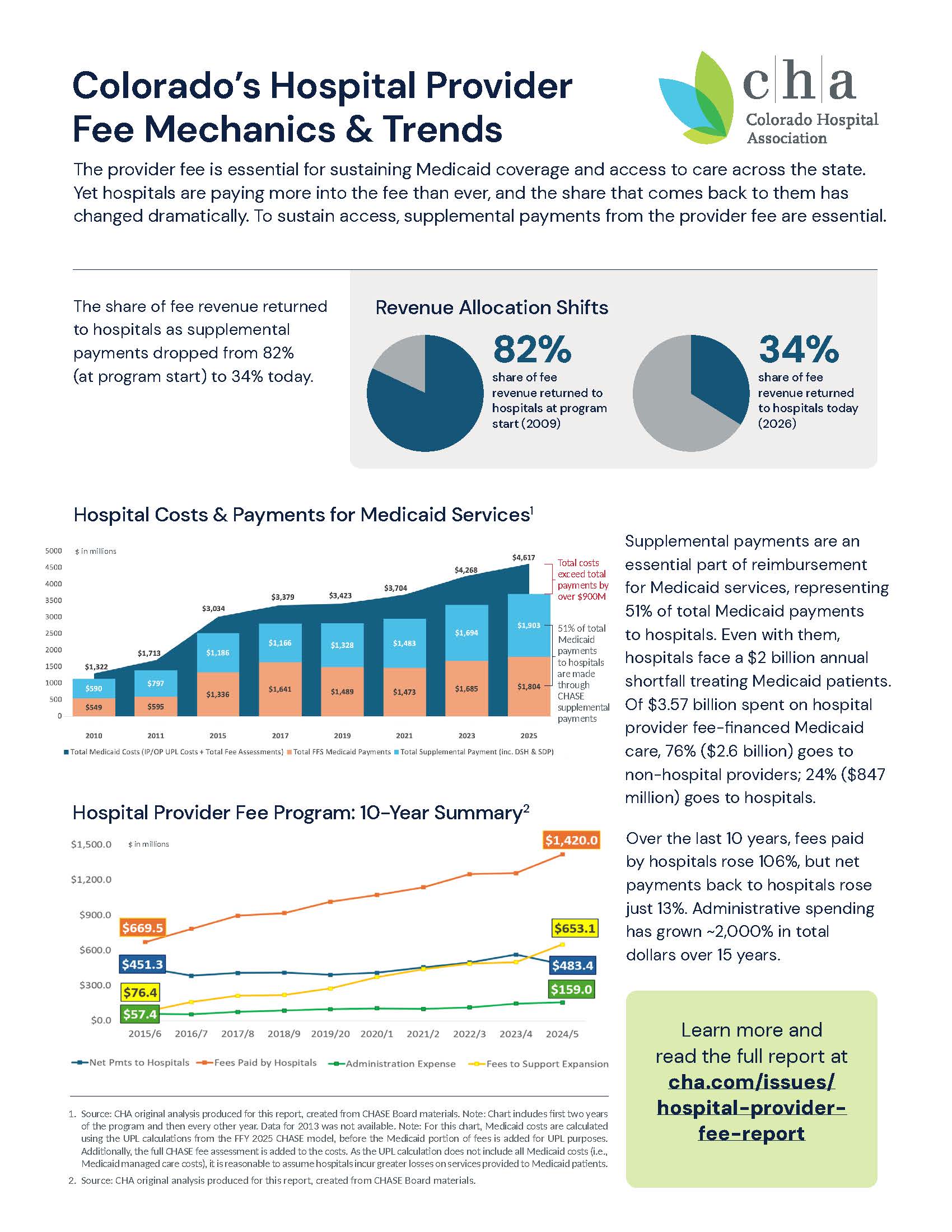
HPF Mechanics and Trends
Download PDF ↓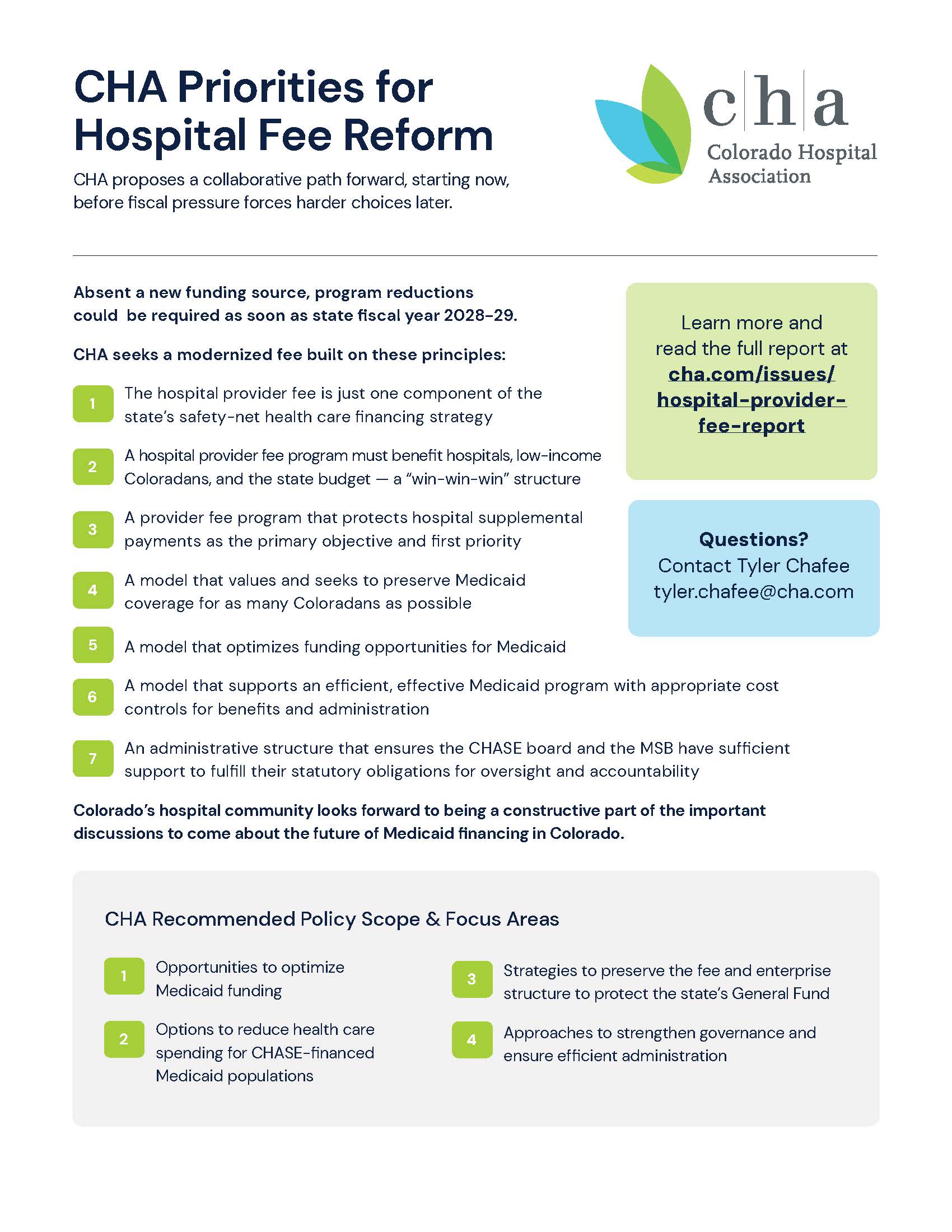
Priorities for HPF Reform
Download PDF ↓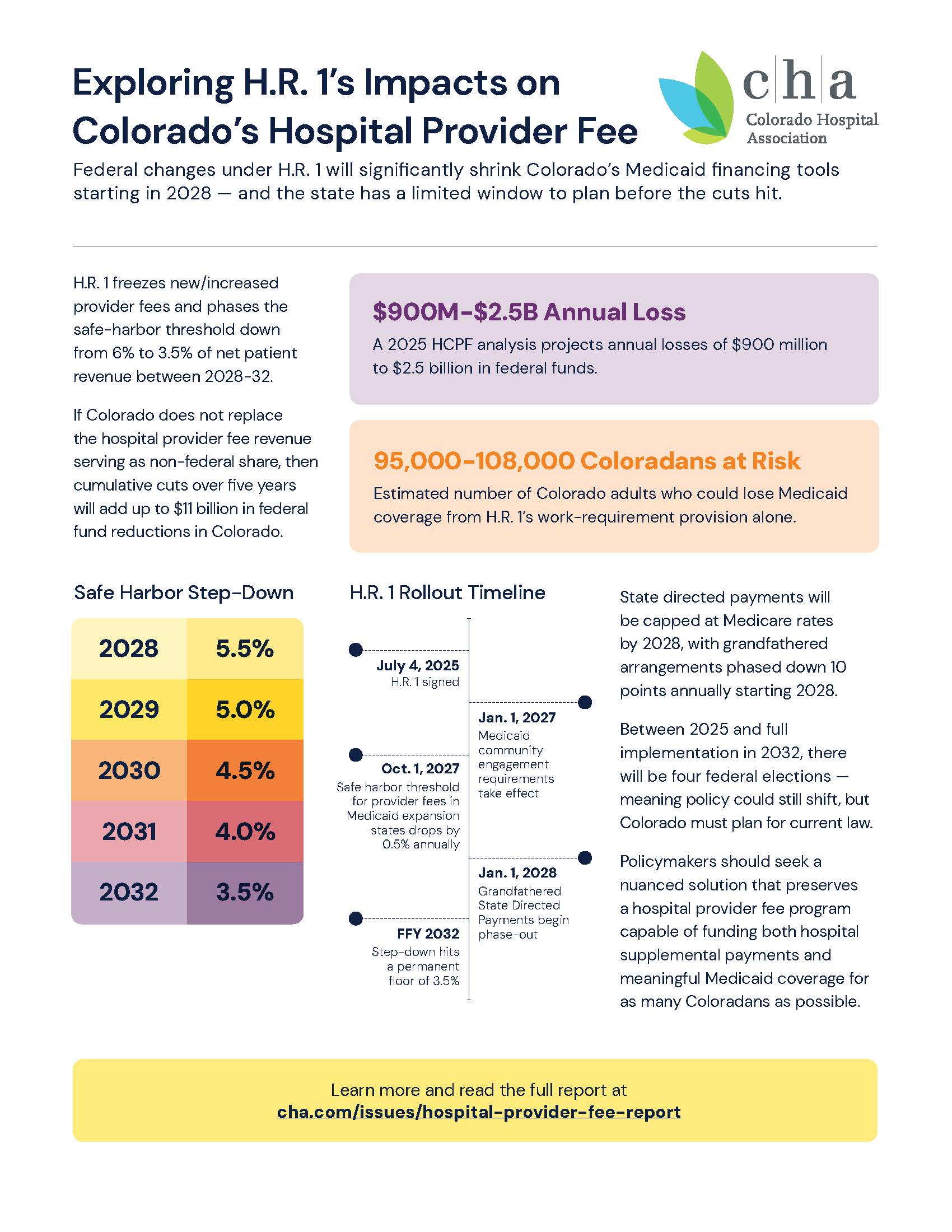
Exploring H.R. 1's Impacts on Colorado's Hospital Provider Fee
Download PDF ↓Watch on demand
The report, explained
Hear from policy experts about how the hospital provider fee works, what it makes possible and why it matters for Colorado’s health care system.
Frequently asked questions
Start with the essentials
Learn how Colorado’s hospital provider fee works, whom it supports and why modernization of the program is necessary.
What is the hospital provider fee? What is CHASE?
Colorado’s hospital provider fee, created in 2009, is a fee hospitals pay that draws down federal Medicaid matching funds. It is an integral part of Medicaid financing in Colorado. It is part of the Colorado Healthcare Affordability and Sustainability Enterprise (CHASE), a government-owned business that exists within the Colorado Department of Health Care Policy and Financing. It funds hospital supplemental payments and Medicaid coverage. See page 4 of the report for additional detail.
Why did CHA write the report? What is in it? Who is the audience?
CHA wrote this report to build a shared understanding of how Colorado’s hospital provider fee works, its history, and the challenges ahead as federal policy changes will require significant changes to Colorado’s Medicaid program. It’s intended to help Colorado hospital leaders, policymakers, and Medicaid stakeholders prepare for policy discussions on the horizon. See page 43 of the report for additional detail.
What are the key points of this report?
- The hospital provider fee program has grown from $686M (2010) to $5.6B (2025), but its underlying policy hasn’t been updated since 2009.
- The share of revenue funding hospital supplemental payments has dropped from 82% to 34% as the program expanded to fund broader Medicaid coverage.
- Federal policy changes made through H.R. 1 will lower the amount of funds that can be assessed through Medicaid provider fees from 6% of Net Patient Revenue to 3.5% in 2032, risking up to $11 billion in cumulative federal funding losses to Colorado.
- Coloradans benefit from both hospital supplemental payments, which protect access to care, and Medicaid coverage.
- Modernizing the program must protect its legal fee/enterprise structure through a collaborative, principles-driven process with state and hospital stakeholders.
What comes next? What reform needs to happen to make this sustainable?
CHA is calling for a collaborative, proactive process to modernize the fee – protecting both hospital supplemental payments and Medicaid coverage, to the extent possible, and making meaningful updates to the governance of the program to ensure its long-term sustainability. See page 41–43 of the report for additional detail.
As the General Assembly, what is your role?
The General Assembly’s partnership to create a sustainable future for the hospital provider fee is essential. This is a complex issue with no simple answers, and the hard decisions ahead will require shared leadership to protect hospitals, coverage, and the state budget together. See page 41-43 of the report for additional detail.
History
How/when did legislation pass to create and then update this program?
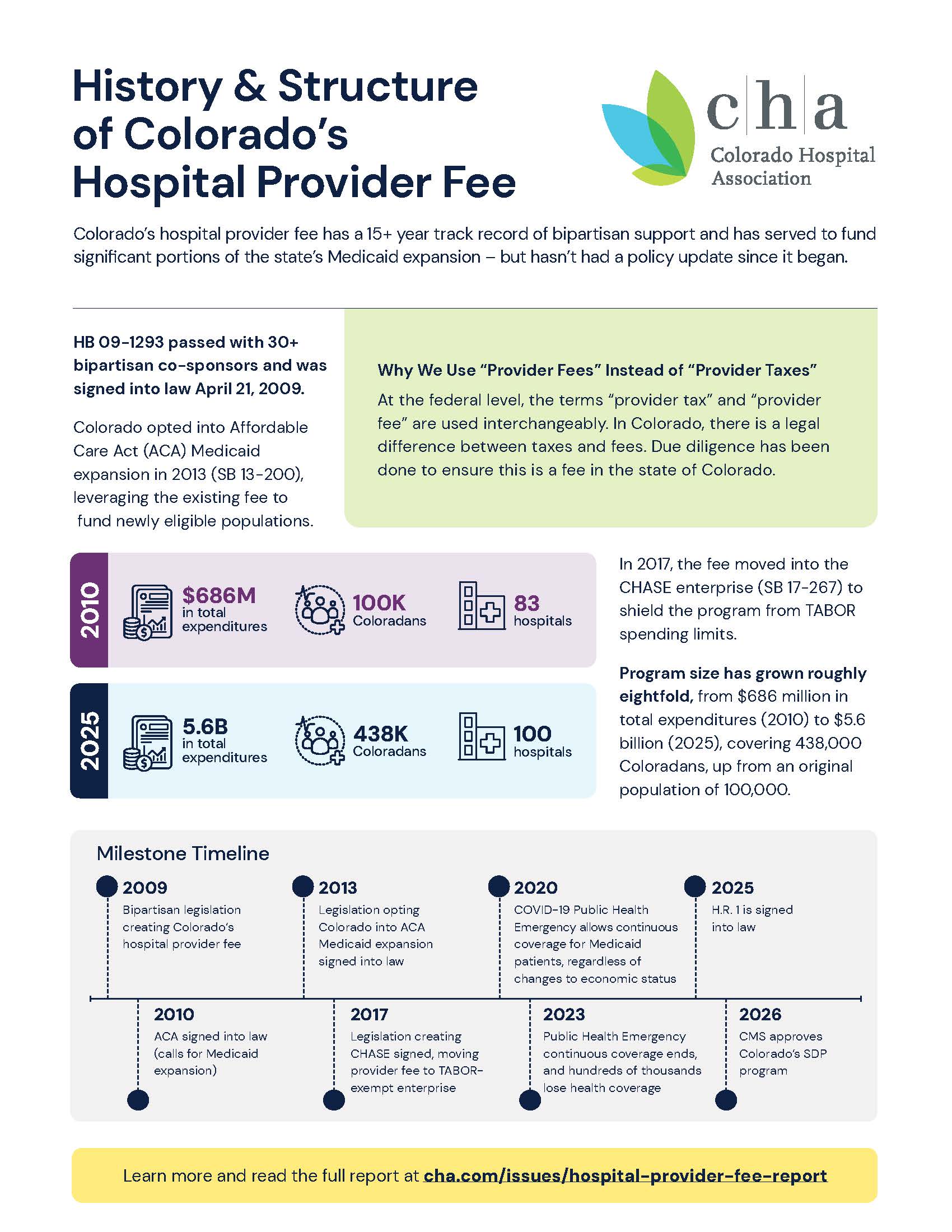
The original hospital provider fee passed as HB 09-1293 with more than 30 bipartisan co-sponsors, signed into law April 2009. The enterprise structure passed via SB 17-267 in 2017, also with bipartisan support. See page 13-19 of the report for additional detail.
How has the hospital provider fee changed over 15 years?
What began as an estimated $680 million program financing Medicaid coverage for 100,000 Coloradans and supplemental payments to hospitals has grown to $5.6 billion in total expenditures, financing Medicaid coverage for 438,000 Coloradans and supporting payments to 100 hospitals — more than an eightfold increase. See page 29 of the report for additional detail.
Is this Colorado's only provider fee?
No. Colorado now has three provider fees: one for hospitals, one for nursing homes, and one for intermediate care facilities. The hospital provider fee generates significantly more revenue than the other two. All three provider fees operate under the CHASE. See page 11 of the report for additional detail.
How common are provider fees?
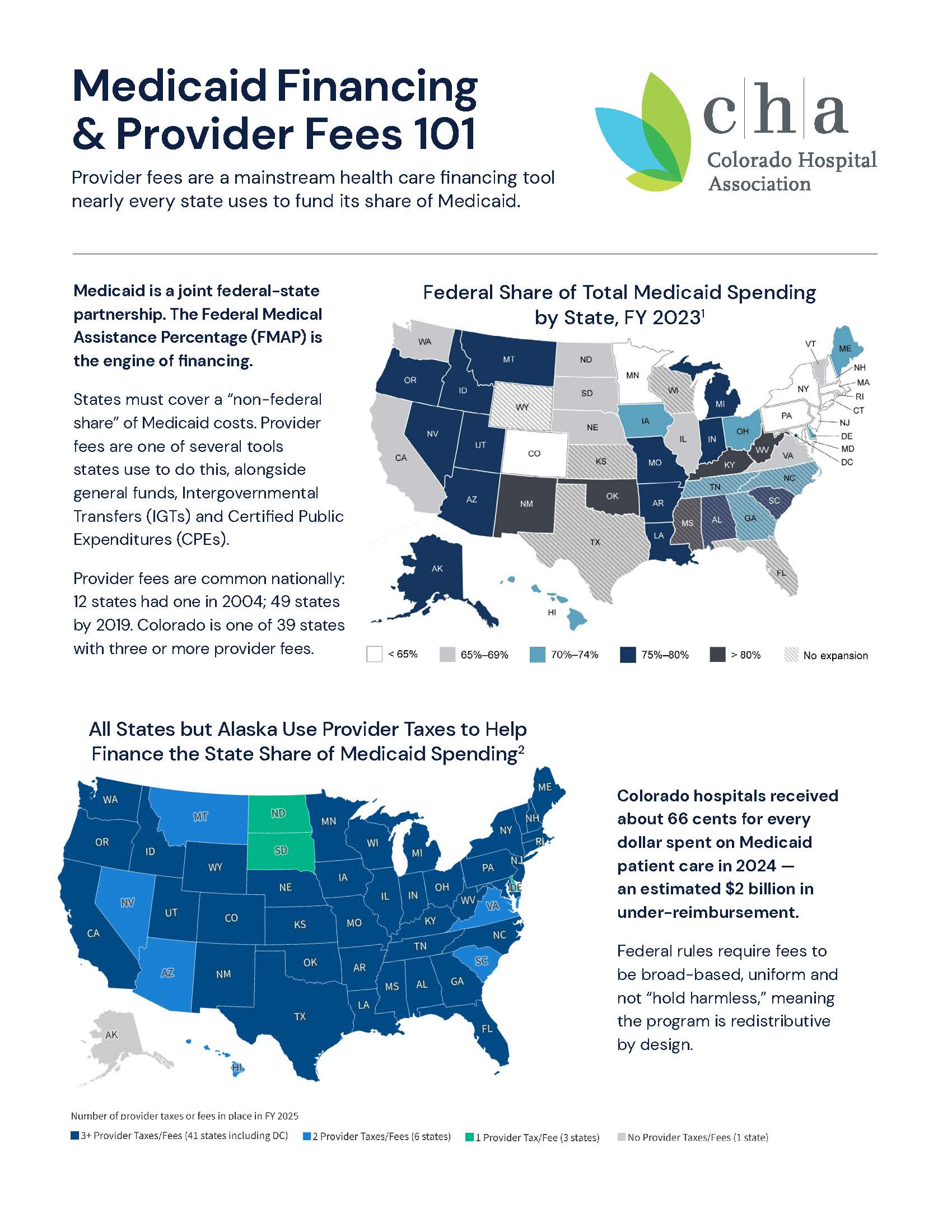
Hospital provider fees are common nationally: only 12 states had one in 2004, growing to 49 states by 2019. As of December 2025, Colorado is one of 41 states with three or more provider fees. See page 8 of the report for additional detail.
How It Works
What is the UPL program?
The Upper Payment Limit (UPL) program is the traditional fee-for-service structure Colorado’s provider fee has used since 2010, generating supplemental payments to hospitals that help close the gap between cost and reimbursement for Medicaid services. See page 10 of the report for additional detail.
Why are hospital supplemental payments needed?
Supplemental payments fund 51% of total Medicaid payments to hospitals and remain essential to sustaining access to care. However, even with supplemental payments, hospitals face a Medicaid shortfall of more than $900 million a year between reimbursement and the cost of care. See page 38 of the report for additional detail.
How is revenue from the hospital provider fee allocated?
Statute establishes that provider fee revenue (fee + federal match) can fund (1) supplemental payments to hospitals, (2) program administration, and (3) Medicaid coverage for specific populations. When the hospital provider fee began, 82% of revenue funded hospital supplemental payments; today that share is 34%. The rest finances Medicaid coverage, program administration. See page 32 of the report for additional detail.
Is this a tax that patients pay? Who pays the fee?
The hospital provider fee is a fee that is assessed on hospitals. In 2024-25, of 100 hospitals participated in the hospital provider fee program, 15 were exempt from paying fees based on facility type and 38 paid a discounted fee amount, leaving 47 of 100 paying the full fee. See page 23 of the report for additional detail.
How are fees assessed?
Colorado assesses an inpatient fee (per patient day) and an outpatient fee (a percentage of outpatient charges), both calculated relative to Net Patient Revenue (NPR) and capped near the federal 6% safe-harbor threshold. See page 30-31 of the report for additional detail.
Other Components
What is the new State Directed Payments program? Why was it created?
Colorado’s new State Directed Payments (SDP) program lets the state draw down enhanced federal match funding for Medicaid managed care services, complementing the traditional fee-for-service model. CMS approved Colorado’s SDP in April 2026 to better support managed care populations and stabilize safety-net financing. See page 24 of the report for additional detail.
Federal Impacts
What provisions of H.R. 1 pertain to the HPF, and when do they take effect?
H.R. 1 freezes new or increased provider fees, phases down the 6% safe-harbor threshold to 3.5% by 2032, and caps state directed payments at Medicare rates by 2028. Most changes begin in federal fiscal year 2028. In Colorado, this will result in more than $11 billion in reduced health care funding. See Section 4, starting on page 35 of the report for additional detail.
Is this part of the ACA?
Not entirely. Colorado’s hospital provider fee was created in 2009, one year before the ACA was approved by Congress and four years before Colorado opted into the ACA Medicaid expansion. When Colorado opted in to the expansion in 2013, it leveraged the existing fee to finance incremental expansions and capture enhanced federal funding available through the ACA. See page 15-16 of the report for additional detail.
Impact
How does the hospital provider fee benefit patients?
CHASE finances Medicaid and CHP+ coverage for 438,452 Coloradans – just over 34% of the state’s total Medicaid population – helping ensure access to essential health services for low-income residents statewide. See page 27 of the report for additional detail.
How does the hospital provider fee benefit rural communities?
Most hospitals in rural Colorado qualify for discounted hospital provider fee rates so that the benefit to rural hospitals is greater than many urban counterparts. 68% of the state’s rural Critical Access Hospitals’ Medicaid reimbursement coming from hospital provider fee supplemental payments. The hospital provider fee is essential to keeping some rural hospitals financially viable. See page 39 of the report for additional detail.
How does the hospital provider fee benefit kids?
CHASE funds CHP+ coverage for children (and pregnant individuals) with incomes up to 250% FPL, plus 12 months of continuous Medicaid eligibility for children – provisions built into the program since 2009. It also supports supplemental payments to hospitals helping to ensure kids – and all Coloradans – can access care. See page 27 of the report for additional detail.
How does the hospital provider fee benefit the disability community?
The hospital provider fee funds the Medicaid Buy-In Program for adults and children living with disabilities with incomes up to 450% FPL – one of the five population categories authorized in the original 2009 statute. This program now serves 27,000 Coloradans. See pages 19 and 27 of the report for additional detail.
How does the hospital provider fee benefit the business community?
Colorado hospitals are major employers and economic engines for their communities. Colorado hospitals provide or support 111,000 jobs in the state, and in rural areas, health care is a top three industry, employing one in 10 rural Coloradans. The hospital provider fee is a crucial financing mechanism for hospitals, helping those organizations continue to provide care for their communities and serve as employers and local economic engines.
How does the hospital provider fee benefit Coloradans not on Medicaid?
Without CHASE supplemental payments, hospitals would need General Fund dollars to cover Medicaid losses or risk cutting services – an outcome that would threaten access to care for all Coloradans, not just Medicaid patients. See page 33 of the report for additional detail.
Overview
What is the hospital provider fee? What is CHASE?
Why did CHA write this report, and who is it for?
What are the report’s key points?
What comes next, and what reforms are needed?
What role does the General Assembly play?
Learn More
Recommendations for Additional Reading
Explore the reports, legislation and policy resources referenced throughout the report.
Section 1 Medicaid Financing and Provider Taxes 6 resources
-
Medicaid Financing 101
National Conference of State Legislatures · Updated Jan. 22, 2026 · Retrieved April 2026
-
5 Key Facts About Medicaid and Provider Taxes
KFF · Dec. 1, 2025 · Retrieved April 2026
-
How Medicaid Provider Taxes Work: An Explainer
National Association of Medicaid Directors · Sept. 25, 2025 · Retrieved April 2026
-
Medicaid in Context: Payment and Financing Presentation
Holly Saltrelli and Chris Park · Medicaid and CHIP Payment and Access Commission · April 10, 2025 · Retrieved April 2026
-
Medicaid Provider Taxes
Congressional Research Service · Dec. 30, 2024 · Retrieved April 2026
-
Issue Brief: Health Care-Related Taxes in Medicaid
Medicaid and CHIP Payment and Access Commission · May 2021 · Retrieved April 2026
Section 2 Colorado’s Program History and Structure 7 resources
-
House Bill 09-1293: Colorado Health Care Affordability Act
Colorado General Assembly · Retrieved April 2026
-
Medicaid Hospital Provider Fee Program Performance Audit
Colorado Office of the State Auditor · September 2012 · Retrieved April 2026
-
A Guide to the Supreme Court’s Decision on the ACA’s Medicaid
Expansion
KFF · August 2012 · Retrieved April 2026
-
Senate Bill 13-200: Expand Medicaid Eligibility
Colorado General Assembly · Retrieved April 2026
-
State Government Enterprises
Legislative Council Staff memorandum prepared by Elizabeth Ramey · March 18, 2025 · Retrieved May 2026
-
Senate Bill 17-267: Sustainability of Rural Colorado
Colorado General Assembly · Retrieved April 2026
-
Improving Access in Medicaid Managed Care Using State Directed
Payments
Georgetown University McCourt School of Public Policy, Center for Children and Families · July 10, 2024 · Retrieved April 2026
Section 3 CHASE Program Information and Oversight 3 resources
-
2024-25 Report to the Community
Colorado Department of Health Care Policy and Financing · Retrieved June 2026
-
2026 CHASE Annual Report
Reflecting the 2024-25 program year · Colorado Department of Health Care Policy and Financing · Jan. 15, 2026 · Retrieved May 2026
-
CHASE Board Meeting Information and Materials
Colorado Department of Health Care Policy and Financing · Includes public meeting materials and resources related to hospital provider fee mechanics
Section 4 Federal Policy and H.R. 1 5 resources
-
How New Limits on State Provider Taxes Will Affect Medicaid
Funding
The Commonwealth Fund · Dec. 19, 2025 · Retrieved June 2026
-
Five Key Facts About Medicaid and Provider Taxes
KFF · Dec. 1, 2025 · Retrieved June 2026
-
H.R. 1 Provisions Impacting Colorado Medicaid: Presentation for
Legislative Leadership
Colorado Department of Health Care Policy and Financing · July 2025 · Retrieved June 2026
-
H.R. 1 Resources for Stakeholders, Providers and Partners
Colorado Department of Health Care Policy and Financing · Accessed June 2026
-
State-by-State Estimates of Medicaid Expansion Coverage Losses
Under a Federal Work Requirement
Urban Institute · April 14, 2025 · Retrieved June 2026
Questions about the report?